Neighbours Rise as One: Hindu and Muslim Residents Rush to Help Christian Family After House Fire in Uttar Pradesh
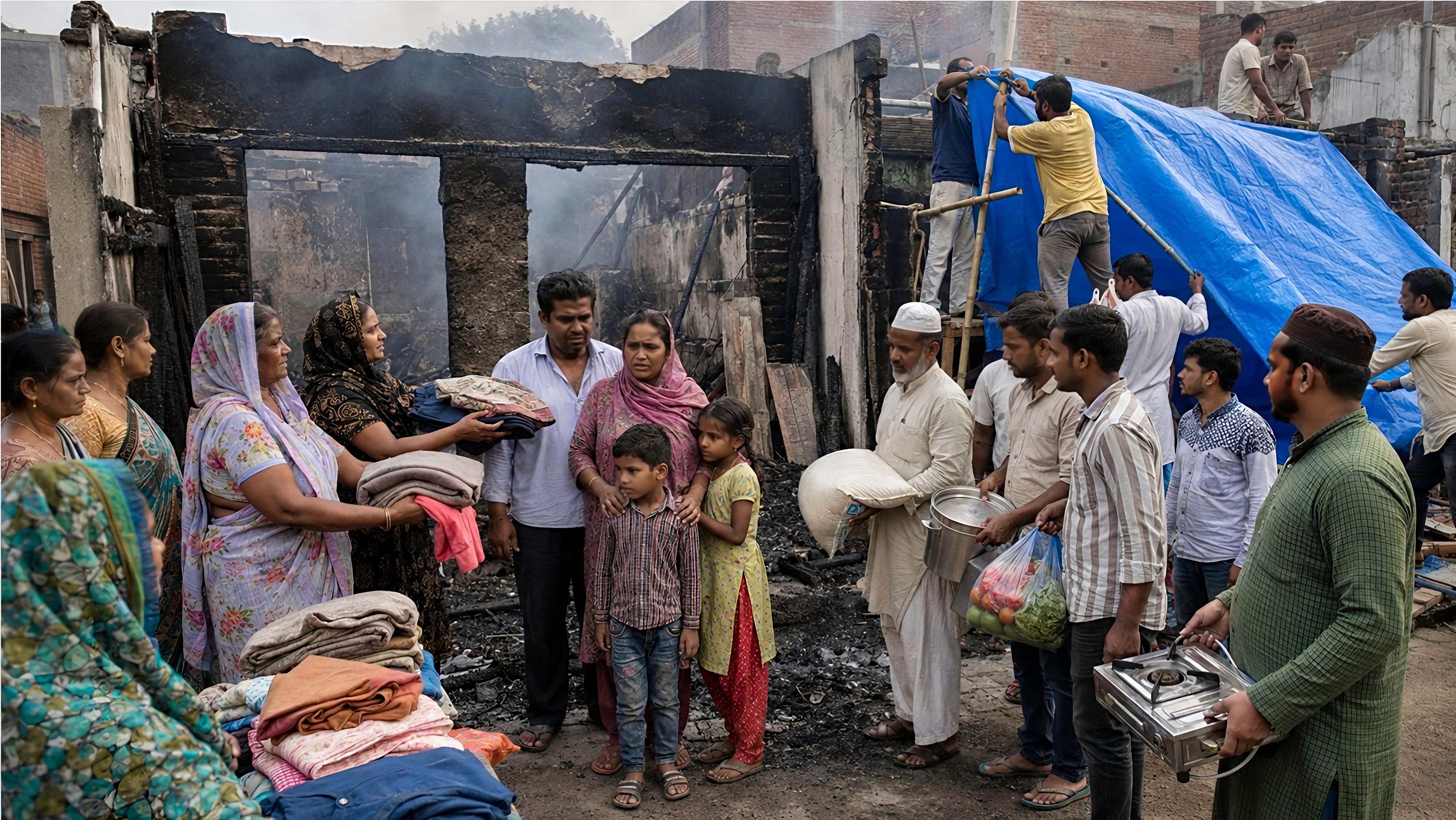
When flames destroyed a Christian family’s modest home in a mixed neighbourhood of Uttar Pradesh, local Hindu and Muslim residents didn’t wait for official help — they immediately stepped in with clothes, food packets, blankets and temporary shelter materials, showing that compassion can cross every line of caste, faith and background.
Mid-March 2026. The fire broke out suddenly in the small settlement near Lucknow, reducing the family’s single-room house to charred remains within minutes. The Christian couple and their two young children stood in shock amid the smoke, left with nothing but the clothes on their backs. In many places, such a crisis might have meant long waits for government aid or distant relatives. But here, the response was instant and deeply personal.
Within hours, Hindu and Muslim neighbours from the same street and surrounding lanes began arriving with whatever they could gather. Women from Hindu households brought fresh sets of clothes for the children and sarees for the mother. Muslim families contributed warm blankets, rice, dal, vegetables and even a few gas cylinders for cooking. Young men from both communities worked together to rig up a temporary shelter using tarpaulin sheets and bamboo poles borrowed from a nearby construction site. Someone brought a small stove and cooking utensils so the family could at least prepare a hot meal that same evening.
There were no announcements, no photo-ops, and no formal meetings. Just ordinary people acting on instinct — the same neighbours who had shared tea across doorsteps for years, celebrated each other’s festivals, and helped during previous hardships. A local Hindu shopkeeper quietly paid for new school uniforms for the children, while a Muslim auto-driver offered daily rides to the father until he could restart his work.
In the days that followed, the family spoke with quiet emotion about how the support felt like an extended family rallying around them. The gesture was especially meaningful for a Christian household often navigating multiple layers of marginalisation. In a moment of loss, the mixed neighbourhood chose unity over division, proving that everyday bonds can become lifelines when it matters most.
This was not a large-scale organised relief effort — it was the simple, heartfelt response of people who see each other as neighbours first. In mid-March 2026, that small corner of Uttar Pradesh quietly reminded everyone that real harmony often shows up first in the form of a warm blanket and a helping hand when someone has lost everything.